How to Solve Second-Degree Trigonometric Equations

In the first two parts of this series, we looked at first-degree trigonometric equations on standard intervals, non-standard intervals, and with general solutions.
If you'd like, you can first read:
How to Solve First-Degree Trigonometric Equations on the Standard Interval and How to Solve Trigonometric Equations on Non-Standard Intervals and Write General Solutions
This third part moves to a new type of problem: second-degree trigonometric equations.
These are equations where the trig function appears in a quadratic form, such as:
2sin²θ − 3sinθ + 1 = 0
or
3tan²θ + 5tanθ − 2 = 0
The key idea is that these are not solved directly in one step. Instead, you first treat the trig expression like a quadratic, solve that quadratic, and then solve the first-degree trig equations that come out of it.
The two main algebraic methods are:
Factoring
The quadratic formula
Both are valid. Factoring is usually faster when it works, but it does not always work nicely. The quadratic formula always works, but it is usually more tedious.
In this post, we will focus on solving these equations on the standard interval:
0° ≤ θ < 360°
or
0 ≤ θ < 2π
What Is a Second-Degree Trig Equation?
A second-degree trigonometric equation is one where the trig function behaves like the variable in a quadratic.
For example:
2sin²θ − 3sinθ + 1 = 0
If we temporarily let:
x = sinθ
then the equation becomes:
2x² − 3x + 1= 0
Now it is just a regular quadratic equation.
Once we solve for x, we substitute back to get trig equations like:
sinθ = 1/2 or sinθ = 1
Then we solve those using the methods from the earlier posts.
So the overall strategy is:
Rewrite the equation as a quadratic in one trig function
Solve the quadratic
Turn the results back into first-degree trig equations
Solve for all angles in the interval
Method 1: Factoring
Factoring is often the fastest method, but only when the quadratic breaks apart cleanly.
Example 1: A Factoring Question
Solve:
2sin²θ − 3sinθ + 1 = 0, 0° ≤ θ < 360°
Step 1: Treat it like a quadratic
Let:
Let x = sinθ
Then:
2x² − 3x + 1 = 0
Step 2: Factor
We want two numbers that multiply to 2 ⋅ 1 = 2 and add to −3
Those numbers are −2 and −1, so:
2x² − 3x + 1 = 0 becomes
(x − 2)(x − 1) = 0
Set each factor equal to zero:
x − 2 = 0 or x − 1 = 0
So:
x = 1/2 or x = 1
Substitute back:
sinθ = 1/2 or sinθ = 1
Step 3: Solve each trig equation
First equation:
sinθ = 1/2
Sine is positive in Quadrants I and II, and the reference angle is 30°, so:
θ = 30°, 150°
Second equation:
sinθ = 1
That happens at:
θ = 90°
Final answer:
θ = 30°, 90°, 150°
When Is Factoring Likely to Work?
Factoring over the rational numbers works nicely when the quadratic has rational roots.
A useful test for this is the discriminant:
D = b² − 4ac
For a quadratic:
ax² + bx + c = 0
If the discriminant is positive and a perfect square, then the roots are rational, which means the quadratic can be factored using rational numbers.
For example, in:
2x² − 3x + 1 = 0
the discriminant is:
D = (−3)² − 4(2)(1) D = 9 − 8
D = 1
Since 1 is positive and a perfect square, factoring over the rationals is possible.
That does not mean you must factor, but it is a good sign that factoring should work cleanly.
Strengths of Factoring
It is usually faster than the quadratic formula
It can produce clean answers with less arithmetic
It helps students see the structure of the quadratic
Weaknesses of Factoring
It does not always work nicely
Some quadratics do not factor over the rationals
Students can waste time trying to force a factorization that is not there
Method 2: The Quadratic Formula
The quadratic formula always works for quadratic equations, so it is the most reliable method.
If:
ax² + bx + c = 0
then:
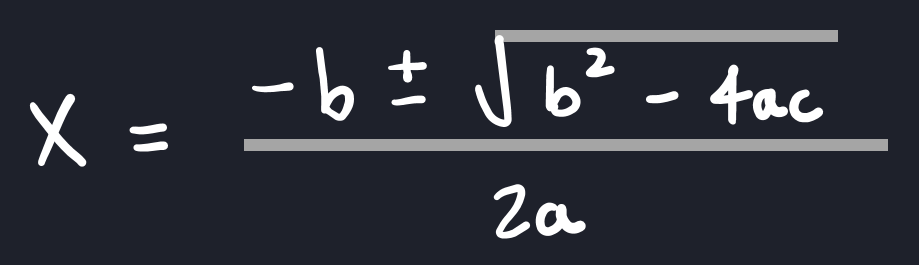
In trig problems, you use it after treating the trig function like the variable.
Example 2: A Quadratic Formula Question
Solve:
2cos²θ + cosθ − 1 = 0, 0° ≤ θ < 360°
This one actually can be factored, but it is a good example for showing the formula method.
Step 1: Let
x = cosθ
Then the equation becomes:
2x² + x − 1 = 0
Step 2: Apply the quadratic formula
Here:
a = 2
b = 1
c = −1
So:

This gives:
x = 2/4 = 1/2 or x = −4/4 = −1
Substitute back:
cosθ = 1/2 or cosθ = −1
Step 3: Solve each trig equation
First equation:
cosθ = 1/2
Cosine is positive in Quadrants I and IV, and the reference angle is 60°, so:
θ = 60°, 300°
Second equation:
cosθ = −1
That happens at:
θ = 180°
Final answer:
θ = 60°, 180°, 300°
Why the Quadratic Formula Is So Reliable
The biggest advantage of the quadratic formula is that it does not depend on you spotting factors.
You just identify a, b, and c, substitute carefully, simplify, and continue.
That makes it more conceptually straightforward for many students. It is a number-crunching method. As long as the arithmetic is handled carefully, it works.
Strengths of the Quadratic Formula
It always works
It removes the guesswork of factoring
It is often more reliable under pressure
Weaknesses of the Quadratic Formula
It is usually more time-consuming
It involves more arithmetic, so there is more room for calculator or sign mistakes
It can feel less elegant when the quadratic factors easily
A Very Important Check: Are the Trig Values Even Possible?
After solving the quadratic, you must make sure the resulting trig values actually make sense.
For sine and cosine, the value must lie between −1 and 1.
So if you ever get something like:
sinθ = 5/3
or
cosθ = −1.4
that is impossible, because sine and cosine cannot be bigger than 1 or smaller than −1.
Those values must be rejected.
For tangent, this issue does not arise in the same way, because tangent can take any real value.
Example 3: Rejecting an Impossible Value
Solve:
sin²θ − 5sinθ + 4 = 0, 0° ≤ θ < 360°
Let:
x = sinθ
Then:
x² − 5x + 4 = 0
Factor:
(x − 1)(x − 4) = 0
So:
x = 1 or x = 4
Substitute back:
sinθ = 1 or sinθ = 4
But sinθ = 4 is impossible, so we reject it.
That leaves:
sinθ = 1
which gives:
θ = 90°
Final answer:
θ = 90°
Which Method Should You Use?
A good practical rule is this:
Use factoring when:
the quadratic looks simple
the discriminant is positive and a perfect square
you can spot the factors quickly
Use the quadratic formula when:
the factoring is not obvious
the discriminant is not a perfect square
you want a method that always works
In many classrooms, students are encouraged to try factoring first. That is reasonable, but only briefly. If the factoring is not appearing quickly, it is often smarter to move to the quadratic formula instead of wasting time.
Summary of the Full Process
When solving a second-degree trig equation:
Step 1
Rewrite the equation as a quadratic in one trig function
Step 2
Solve the quadratic using either:
factoring, or
the quadratic formula
Step 3
Substitute back to get first-degree trig equations
Step 4
Solve each trig equation on the required interval
Step 5
Reject impossible sine or cosine values if necessary
Final Thoughts
Second-degree trigonometric equations are really a combination of two skills:
solving quadratics
solving first-degree trig equations
That is why the problems can feel harder at first. You are doing two layers of mathematics, not one.
The good news is that the method is very structured. Once you recognize the quadratic form, the problem becomes much more manageable.
Factoring is faster when it works. The quadratic formula is more reliable because it always works. A strong student should be comfortable with both, and should know when each method is the better choice.
Need help with solving second-degree trigonometric equations? If you’re in Winnipeg and looking for a tutor, Tutor Advance provides expert one-on-one support!