How to Solve First-Degree Trigonometric Equations on the Standard Interval
Updated: Apr 22

Solving first-degree trigonometric equations is one of the most important skills in introductory trigonometry. Once students move beyond simply evaluating sine, cosine, and tangent, they need to learn how to work backward: given a trig value, determine which angle or angles produce it.
At first, this can feel tricky. A calculator may give one angle, but often there is more than one correct answer in the interval. In other cases, the value is exact, so using a calculator is not even the best approach. And sometimes the answer is not based on a reference angle at all, but instead comes from a quadrantal angle on the axes.
The good news is that these problems become much easier once you sort them into a few clear categories.
In this post, we will look at three main types of first-degree trigonometric equations:
Equations where you can use a special triangle to find the reference angle
Equations where you must use a calculator to find the reference angle
Equations where the solution is a quadrantal angle
For each type, the goal is the same: find all angles that satisfy the equation within a standard interval, usually
0° ≤ θ < 360°
0 ≤ θ < 2π
For radian questions, I generally recommend solving the problem in degrees first and then converting the final answers to radians at the end. In many cases, this is simpler, faster, and less error-prone.
A Quick Foundation: Reference Angles and Quadrants
Before solving trigonometric equations, students need two important ideas:
1. Reference angle
A reference angle is the acute angle formed between the terminal arm of an angle and the x-axis.
For example, all of the following angles have a reference angle of 30°:
30°
150°
210°
330°
The reference angle tells us the basic trig ratio we are working with. The quadrant tells us whether the trig value is positive or negative.
2. Signs of trig functions by quadrant
Sine
Positive in Quadrants I and II
Negative in Quadrants III and IV
Cosine
Positive in Quadrants I and IV
Negative in Quadrants II and III
Tangent
Positive in Quadrants I and III
Negative in Quadrants II and IV
This sign information is essential. Even if you know the reference angle, you still need the correct quadrants to find the full solution set.
Solving Trigonometric Equations Using a Special Triangle
This first type occurs when the trig value is a familiar exact value, such as:
1/2
√3/2
√2/2 or 1/√2
1
√3
√3/3 or 1/√3
In these cases, you should not begin with a calculator. Instead, you should use one of the two special triangles:
the 45−45−90 triangle
the 30−60−90 triangle
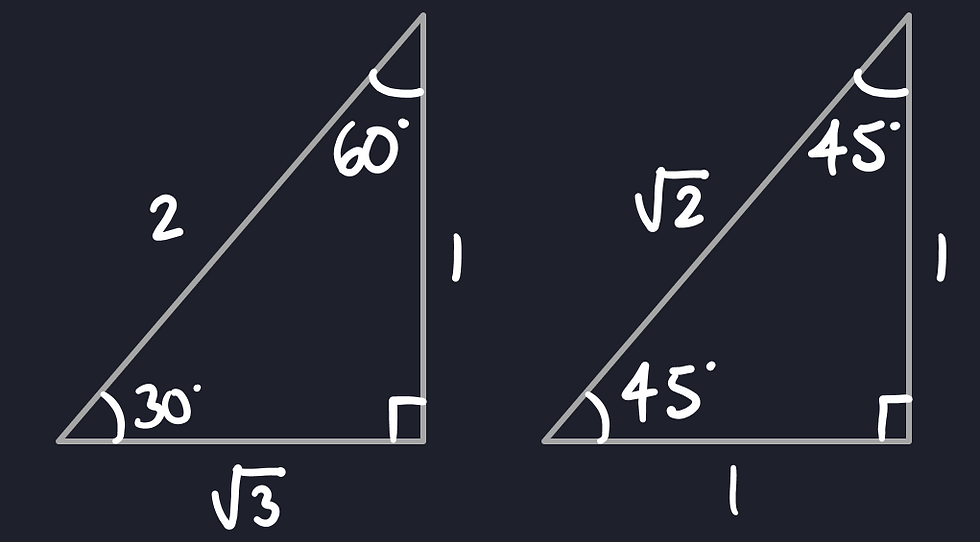
The method
Step 1
Determine which quadrants the angle must lie in by using:
the trig function
the sign of the value
Step 2
Use the appropriate special triangle to find the reference angle.
Step 3
Use the quadrants from Step 1 and the reference angle from Step 2 to find all solutions in the required interval.
Example in Degrees
Solve:
tanθ = −1, 0° ≤ θ < 360°
Step 1: Identify the correct quadrants
Tangent is negative in:
Quadrant II
Quadrant IV
So the solutions must lie in Quadrants II and IV.
Step 2: Find the reference angle
We need the angle whose tangent has magnitude 1.
From the 45−45−90 triangle:
opposite = 1
adjacent = 1
So: tan(45°) = 1
Therefore, the reference angle is: 45°
Step 3: Find the actual angles
Now place the reference angle into the correct quadrants.
In Quadrant II: 180° − 45° = 135°
In Quadrant IV: 360° − 45° = 315°
Final answer:
θ = 135°, 315°
Example in Radians
Solve:
cosθ = −√3/2, 0 ≤ θ < 2π
Step 1: Identify the correct quadrants
Cosine is negative in:
Quadrant II
Quadrant III
So the solutions must lie in Quadrants II and III.
Step 2: Find the reference angle
We want the angle whose cosine has magnitude √3/2
From the 30-60-90 triangle:
cos30° = √3/2
So the reference angle is:
30°
Step 3: Find the actual angles in degrees first
In Quadrant II:
180° − 30° = 150°
In Quadrant III:
180° + 30° = 210°
Now convert to radians:
150° = 150π/180 = 5π/6
210° = 210π/180 = 7π/6
Final answer:
θ = 5π/6, 7π/6
Why this method works
When the trig value is exact, the problem is really testing whether you recognize the basic angle from a special triangle. Once you know the reference angle, the rest is a quadrant question.
This is why students should train themselves to think:
What is the sign?
Which quadrants fit?
Which special triangle gives that exact value?
What are the full angles in the interval?
Solving Trigonometric Equations Using a Calculator
The second type of first-degree trig equation happens when the value is not a standard exact value.
Examples include:
0.42
−0.63
2.4
−1.7
In these situations, the overall process is almost the same. The only difference is that Step 2 uses inverse trig on a calculator rather than a special triangle.
The method
Step 1
Determine the correct quadrants using the trig function and the sign.
Step 2
Use inverse trig on your calculator to find the reference angle (make sure to always input the exact value as a positive into your calculator, even if it's actually negative).
Step 3
Use the reference angle and the quadrants to find all solutions in the stated interval
A common mistake is to stop after using inverse trig once. Your calculator usually gives one principal angle, not every answer.
Example in Degrees
Solve:
sinθ = 0.42, 0° ≤ θ < 360°
Step 1: Identify the correct quadrants
Sine is positive in:
Quadrant I
Quadrant II
So the solutions must lie in Quadrants I and II.
Step 2: Find the reference angle
Use inverse sine:
θᵣ = sin⁻¹(0.42)
Using a calculator:
θᵣ = 24.8°
Step 3: Find the actual angles
In Quadrant I:
θ = 24.8°
In Quadrant II:
θ = 180° − 24.8° = 155.2°
Final answer:
θ = 24.8°, 155.2°
Example in Radians
Solve:
tanθ = 2.4, 0 ≤ θ < 2π
Step 1: Identify the correct quadrants
Tangent is positive in:
Quadrant I
Quadrant III
So the solutions must lie in Quadrants I and III.
Step 2: Find the reference angle
Use inverse tangent:
θᵣ = tan⁻¹(2.4)
Using a calculator:
θᵣ = 67.38°
Step 3: Find the actual angles
The first solution is in Quadrant I:
θ = 67.38°
The second solution is in Quadrant III:
θ = 180° + 67.38° = 247.38°
Now convert to radians:
67.38° ⋅ (π/180°) = 1.18
247.38° ⋅ (π/180°) = 4.32
Final answer:
θ = 1.18, 4.32
A helpful note about calculator work
Students often assume that pressing sin⁻¹, cos⁻¹, or tan⁻¹ gives the full answer. It does not.
It only gives a reference angle or a principal angle. You still need to think about which quadrants work in the given interval.
That is why the calculator does not replace understanding. It only helps with the angle size.
Solving Trigonometric Equations with Quadrantal Angles
The third type occurs when the solution lands exactly on one of the axes.
These are called quadrantal angles.
The four most important unit circle points are:
(1, 0) corresponding to 0° or 0
(0, 1) corresponding to 90° or π/2
(−1, 0) corresponding to 180° or π
(0, −1) corresponding to 270° or 3π/2
These points are especially useful because:
cosine is the x-coordinate
sine is the y-coordinate
tangent is y/x, where defined
In these problems, you usually do not need a reference angle at all. Instead, you identify which of the four basic points produces the correct value.
Example in Degrees
Solve:
cosθ = 0, 0° ≤ θ < 360°
Step 1: Interpret cosine as the x-coordinate
We want:
x = 0
Among the four basic unit circle points, the ones with x-coordinate 0 are:
(0, 1)
(0, −1)
These correspond to:
90°
270°
Final answer:
θ = 90°, 270°
Example in Radians
Solve:
sinθ = −1, 0 ≤ θ < 2π
Step 1: Interpret sine as the y-coordinate
We want:
y = −1
Among the four basic unit circle points, that happens at:
(0, −1)
This corresponds to: 3π/2
Final answer:
θ = 3π/2
Other common quadrantal cases
If sinθ = 0
Since sine is the y-coordinate, we need y = 0. That happens at:
(1, 0), which is 0° or 0
(−1, 0), which is 180° or π
If cosθ = 1
Since cosine is the x-coordinate, we need x = 1. That happens at:
(1,0), which is 0° or 0
If cosθ = −1
We need x = −1. That happens at:
(−1, 0), which is 180° or π
If tanθ = 0
Since tangent is y/x, it equals 0 when y = 0 and x ≠ 0. That happens at:
0° and 180°
or 0 and π
A Reliable Strategy for Solving First-Degree Trig Equations
No matter what specific question you are given, most first-degree trigonometric equations fall into one of these three patterns.
If the value is an exact value
Use this process:
Identify the trig function and sign
Determine the correct quadrants
Use a special triangle to find the reference angle
Find all angles in the interval
If the value is a decimal
Use this process:
Identify the trig function and sign
Determine the correct quadrants
Use inverse trig on a calculator to find the reference angle
Find all angles in the interval
If the value is a quadrantal value
Use this process:
Match the trig value to x, y, or y/x
Use the four basic unit circle points
Write all solutions in the interval
Common Mistakes to Avoid
1. Giving only one answer
This is probably the most common mistake. Many trig equations have two solutions in the interval from 0° to 360°, or from 0 to 2π.
2. Ignoring the sign
Students sometimes find the correct reference angle but place it in the wrong quadrants.
3. Mixing up radians and degrees
Always check your calculator mode. If the problem is in degrees, make sure your calculator is in degree mode. If the problem is in radians, degree mode can still be used temporarily if you plan to convert at the end, but you should be clear and consistent.
4. Treating quadrantal angles like regular reference-angle problems
If the value is 0, 1, or −1, it is often better to think directly in terms of the unit circle points rather than forcing a reference-angle method.
Final Thoughts
First-degree trigonometric equations become much more manageable once students stop seeing them as a random collection of problems and start seeing them as a small set of recognizable cases.
Ask yourself:
Is this an exact value from a special triangle?
Do I need a calculator?
Is this a quadrantal angle?
Once you answer that question, the method becomes much clearer.
In most cases, the real structure is simple:
find the reference angle or basic unit circle position
determine the correct quadrants
list every solution in the required interval
For radian problems, solving in degrees first and converting at the end is often the most student-friendly approach. It keeps the logic clean and helps reduce mistakes.
If students build that habit early, solving trig equations becomes much more systematic and much less intimidating.
Need help with solving first-degree trigonometric equations? If you’re in Winnipeg and looking for a tutor, Tutor Advance provides expert one-on-one support!