Algebra Refresher Part 2: How to Solve Equations with Fractions

Fractions make algebra look much harder than it really is.
A lot of students can solve ordinary linear equations without much trouble, but the moment fractions appear, everything suddenly feels more complicated. The good news is that fraction equations are not a new kind of algebra. They are still just equations where we want to isolate the variable. The only difference is that fractions create extra clutter, so our first job is to clear that clutter away.
This post builds directly on the ideas from Algebra Refresher: How to Solve Equations by Isolating the Variable, where we focused on isolating the variable by breaking the connections attached to it. Here, we will extend that same idea to equations involving fractions.
The Big Idea
When fractions appear in an equation, the easiest approach is usually to clear the denominators first. Once the fractions are gone, the equation becomes a regular linear equation, and you can solve it using the same algebra skills you already know.
A Cleaner Way to Think About the LCD
A simple approach is this:
When finding the LCD, only look at the denominators that actually appear in fractional terms. Whole numbers do not contribute to the LCD.
That does not mean you ignore whole numbers when you multiply through the equation. It just means they do not affect your choice of LCD.
For example, in

the only denominator that appears is 2, so the LCD is 2. The terms m and 4 are whole-number terms, so they do not help determine the LCD.
The 5-Step Method for Solving Fraction Equations
Here is the method we will use:
1. Look only at the denominators that appear in fractions
Ignore terms without fractions when choosing the LCD.
2. Find the LCD
The LCD is the smallest number that all of those denominators divide into evenly.
3. Multiply every term in the equation by the LCD
Even the terms without fractions must be multiplied by the LCD. This keeps the equation balanced.
4. Simplify any fractional terms
This is where the fractions disappear.
5. Solve the linear equation that remains
Once the fractions are gone, continue with ordinary algebra.
Example 1
Solve:
Step 1: Look at the denominators in the fractions
The only fraction in the equation is 13/2, so the only denominator we care about is 2.
Step 2: Find the LCD
The LCD is:
2
Step 3: Multiply every term by the LCD
Multiply every term in the equation by 2:

Step 4: Simplify any fractional terms
On the right side, the fraction 13/2 is being multiplied by 2.
The numerator 13 can therefore "give away" its denominator.

From here, 2/2 simplifies to 1.

Now, we have officially rewritten the equation with fractions as a regular equation:
2m + 8 = 13
Step 5: Solve the equation
Subtract 8 from both sides:
2m + 8 − 8 = 13 − 8
2m = 5
Divide both sides by 2:

On the left-hand side, cancel the two 2s that appear in the numerator and denominator.

Final Answer
m = 5/2
Example 2
Solve:

Step 1: Look at the denominators in the fractions
The denominators that appear are:
5 and 20
The term v is not a fraction, so it does not affect the LCD.
Step 2: Find the LCD
The LCD of 5 and 20 is:
20
Step 3: Multiply every term by the LCD
Multiply every term by 20:

Step 4: Simplify the fractional terms
On the left side, the fraction 4/5 is being multiplied by 20.
The numerator 4 can therefore "give away" its denominator.
Moreover, on the right side, the fraction 41/20 is being multiplied by 20.
The numerator 41 can therefore "give away" its denominator too.

From here, 20/5 simplifies to 4 and 20/20 simplifies to 1.

Now, we have officially rewritten the equation with fractions as a regular equation:
16 + 20v = 41
Rewritten:
20v + 16 = 41
Step 5: Solve the equation
Start with:
20v + 16 = 41
Subtract 16 from both sides to get:
20v = 25
Divide both sides by 20 to get:
v = 25/20
Simplify the fraction to get:
v = 5/4
Final Answer
v = 5/4
Example 3
Solve:

This is a nice example because the fraction is attached directly to the variable by multiplication.
Step 1: Look at the denominators in the fractions
The only denominator that appears in a fraction is:
3
The term −1 is a whole number, so it does not contribute to the LCD.
Step 2: Find the LCD
The LCD is:
3
Step 3: Multiply every term by the LCD
Multiply both sides by 3:

Step 4: Simplify the fractional terms
On the left side, the fraction 2/3 is being multiplied by 3.
The numerator 2 can therefore "give away" its denominator.

From here, 3/3 simplifies to 1.
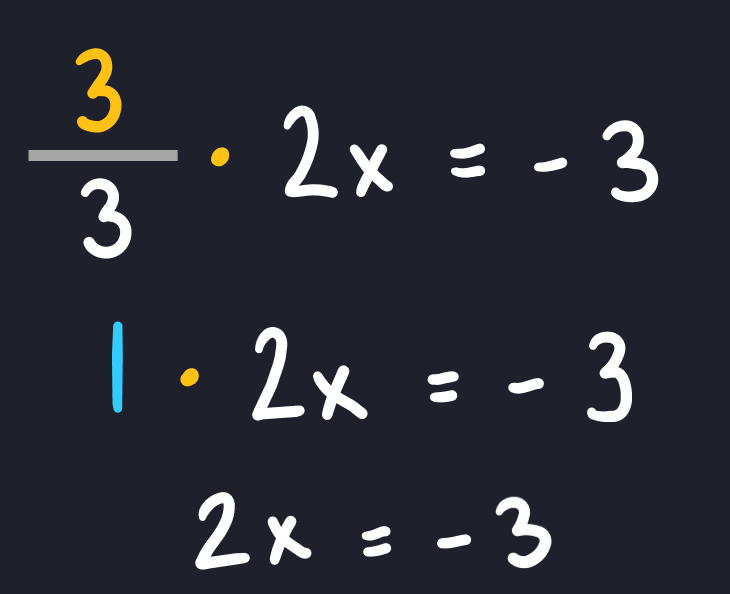
Now, we have officially rewritten the equation with fractions as a regular equation: 2x = −3
Step 5: Solve the equation
Start with:
2x = −3
Divide both sides by 2 to get:
x = −3/2
Final Answer
x = −3/2
Why This Method Works
Students sometimes ask why we are allowed to multiply every term by the LCD.
The reason is simple: we are doing the same thing to both sides of the equation, so the equation stays balanced.
We are not changing the solution. We are only rewriting the equation in a form that is easier to solve.
This matches the same philosophy from the first algebra refresher:
keep the equation balanced,
remove what is getting in the way,
isolate the variable.
Fractions are just another kind of obstacle. The LCD helps us clear them out.
Common Mistakes to Avoid
Forgetting that every term must be multiplied by the LCD
Students sometimes multiply only the fractions and forget the other terms. That makes the equation unbalanced.
For example, in
if the LCD is 20, then every term must be multiplied by 20, including v.
Choosing an LCD based on the whole numbers in the equation
Whole numbers do not contribute to the LCD. Only the denominators inside fractions matter.
Cancelling incorrectly
You can only cancel when there is multiplication. Do not cross out numbers that are part of addition or subtraction.
Stopping too early
Clearing the fractions is only the beginning. After that, you still have to solve the simpler equation that remains.
Final Takeaway
When solving an equation with fractions, keep the process simple:
Look only at the denominators that appear in fractions.
Find the LCD.
Multiply every term by the LCD.
Simplify the fractional terms.
Solve the ordinary linear equation that remains.
That is the whole idea.
Once students realize that fraction equations can be turned into regular equations, a lot of the fear disappears. The equation becomes less intimidating, and the path to the answer becomes much clearer.
If you want the foundational ideas behind isolating variables and breaking algebraic connections, make sure to read the first algebra refresher as well. This post is really just the next step in that same story.
Need help with algebra? If you’re in Winnipeg and looking for a tutor, Tutor Advance provides expert one-on-one support!