Algebra Refresher: How to Solve Equations by Isolating the Variable
Updated: Dec 23, 2025

What Is Algebra, Really?
The word algebra comes from the Arabic word “al-jabr”, which roughly means “reunion” or “putting back together”. It comes from a 9th-century book by the mathematician Al-Khwarizmi about solving equations by moving terms around and restoring balance; that is exactly what we still do today.
Algebra is the art of keeping an equation balanced while you isolate a variable. Everything else is just technique. This refresher is for anyone who needs to rebuild that instinct, from Grade 8 students solving their first equations to university students who feel rusty.
The Main Goal: Get the Variable Alone
When you solve an equation like: 3x + 5 = 17 the real goal is: Get x by itself on one side of the equation. To do that, you undo everything that is attached to x while keeping the equation balanced.
A simple mental picture:
The equal sign is like a seesaw.
Both sides must always have the same “weight”.
Anything you do to one side, you must do to the other.
The Four Fundamental “Connections”
Think of your variable as having connections attached to it. In basic algebra, there are four fundamental ones:
Addition
Subtraction
Multiplication
Division
Each of these can be “unplugged” by its partner:
Addition is undone by subtraction.
Subtraction is undone by addition.
Multiplication is undone by division.
Division is undone by multiplication.
Formally these are called inverse operations, but you can think of them as undo buttons.
Weak vs Strong Connections
It helps students a lot to separate these into two categories.
Weak connections
Addition
Subtraction
These are easy to break off. They sit on the outside of expressions most of the time.
Examples:
x + 7 = 20
x − 3 = 5
3x + 4 = 19
The "+ 7", "- 3", and "+ 4" are weak connections that you can peel away with one move.
Strong connections
Multiplication
Division
These are tighter. They cling directly to the variable.
Examples:
5 · x = 40
x ÷ 3 = 10
(x - 4) ÷ 2 = 10
Here the "5 ·", "÷ 3", and "÷ 2" are strong connections.
Note that all of the following notations denote the product "a times b"
a · b
a × b
ab
(a)b
a(b)
(a)(b)
General Strategy: Break Weak Before Strong
When you solve most equations, you usually:
Break weak connections first (addition or subtraction).
Then break strong connections (multiplication or division).
This matches the idea of “working from the outside in”.
Example 1: Classic two-step equation
Solve:

Weak connection: "+5"
Strong connection: "×3"
Step 1: Break the weak connection
Subtract 5 from both sides:

Step 2: Break the strong connection
Divide both sides by 3:

Now we can cancel out the 3s on the right-hand side of the equation.

Check:
3(4) + 5 = 17 12 + 5 = 17 17 = 17
It works!
When a strong connection breaks a weak one
Sometimes the variable and a weak connection are trapped inside a strong connection. You cannot reach the weak one until you deal with the strong one.
Here is an example:
(x − 4) ÷ 2 = 10
Inside the numerator, there is a weak connection: “− 4” attached to x.
The whole top (x − 4) is locked inside a strong division by 2.
In this situation, you must break the strong connection first so you can get inside.
Example 2: Strong first, then weak
Solve:

Here the strong connection is “÷ 2” applied to the entire top.
Step 1: Break the strong connection
Multiply both sides by 2:
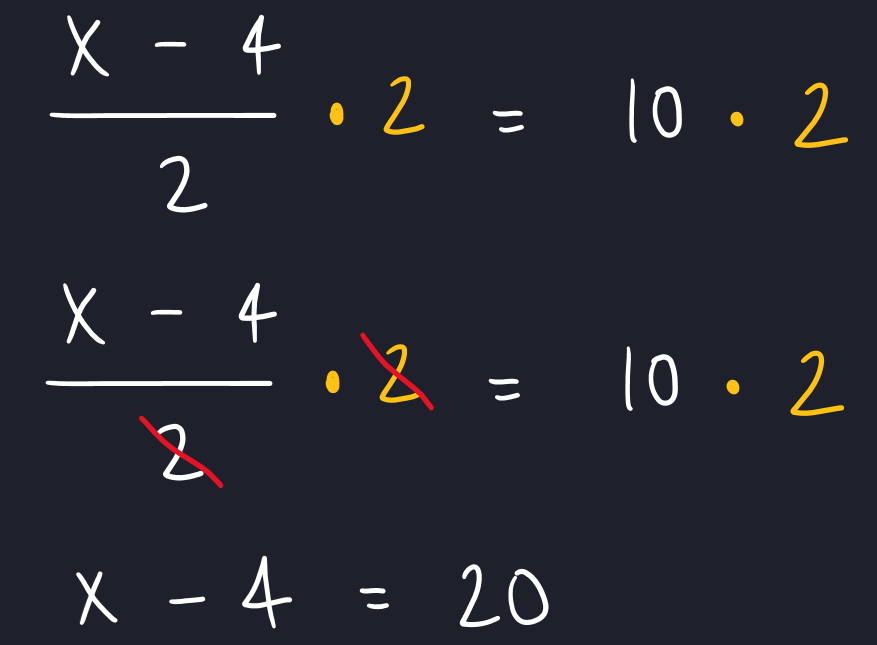
Now the fraction is gone, and the weak connection is accessible.
Step 2: Break the weak connection
Add 4 to both sides:

Check:

It works
So our refined rule is:
Break weak connections first unless a strong connection is wrapped around them. In that case, break the strong one so you can reach the weak ones.
Example 3: Brackets and distribution
Solve:

Here the variable is inside brackets multiplied by 4. You have two main approaches.
Method A: Break weak first (when possible)
Inside the big picture, “− 5” is weak, and “× 4” is strong. So:
Step 1: Break the outside weak connection
Add 5 to both sides:

Now only the strong connection “× 4” remains.
Step 2: Break the strong connection
Divide both sides by 4:

Step 3: Break the remaining weak connection
Subtract 3:

Method B: Distribute first
Here is another way to solve this equation. First, we distribute:

Now it looks like Example 1; let's continue:

Both ways use the same philosophy: peel away weak connections first, unless blocked.
A Common Trap: Moving Things Without “Doing It to Both Sides”
Students sometimes say:
“I moved the 5 to the other side and it changed sign.”
That shortcut is fine once you understand what is really happening, but early on it is much safer to think:
“I am adding or subtracting the same amount from both sides to keep the balance.”
For example, in
x - 7 = 12
people say “move the −7 over and it becomes +7.” What actually happens is:
x - 7 + 7 = 12 + 7 x = 19
The “sign change” is just a side effect of adding 7 to both sides. Keeping that mental picture prevents a lot of sign errors in more complicated problems.
Summary: The Algebra Playbook
When you face an equation, you can follow this checklist.
Decide what you are solving for. Usually it is “get x alone”.
Spot the connections on that variable.
Weak connections: plus, minus
Strong connections: times, divide
Break weak connections first, by doing the opposite operation to both sides.
If a strong connection is wrapped around everything, break it first so you can reach the inside.
Work step by step and keep the balance. Never do something to only one side.
Check your answer by substituting back into the original equation.
Mastering these moves is what makes later topics like functions, graphing, calculus, and even university algebra feel much more manageable. If a student learns to see equations as “variable + connections I can undo”, algebra turns from a mystery into a set of clear, repeatable steps.
Need help with algebra? If you’re in Winnipeg and looking for a tutor, Tutor Advance provides expert one-on-one support!